
Crypto Taxes: 10% or 23%
November 26, 2026
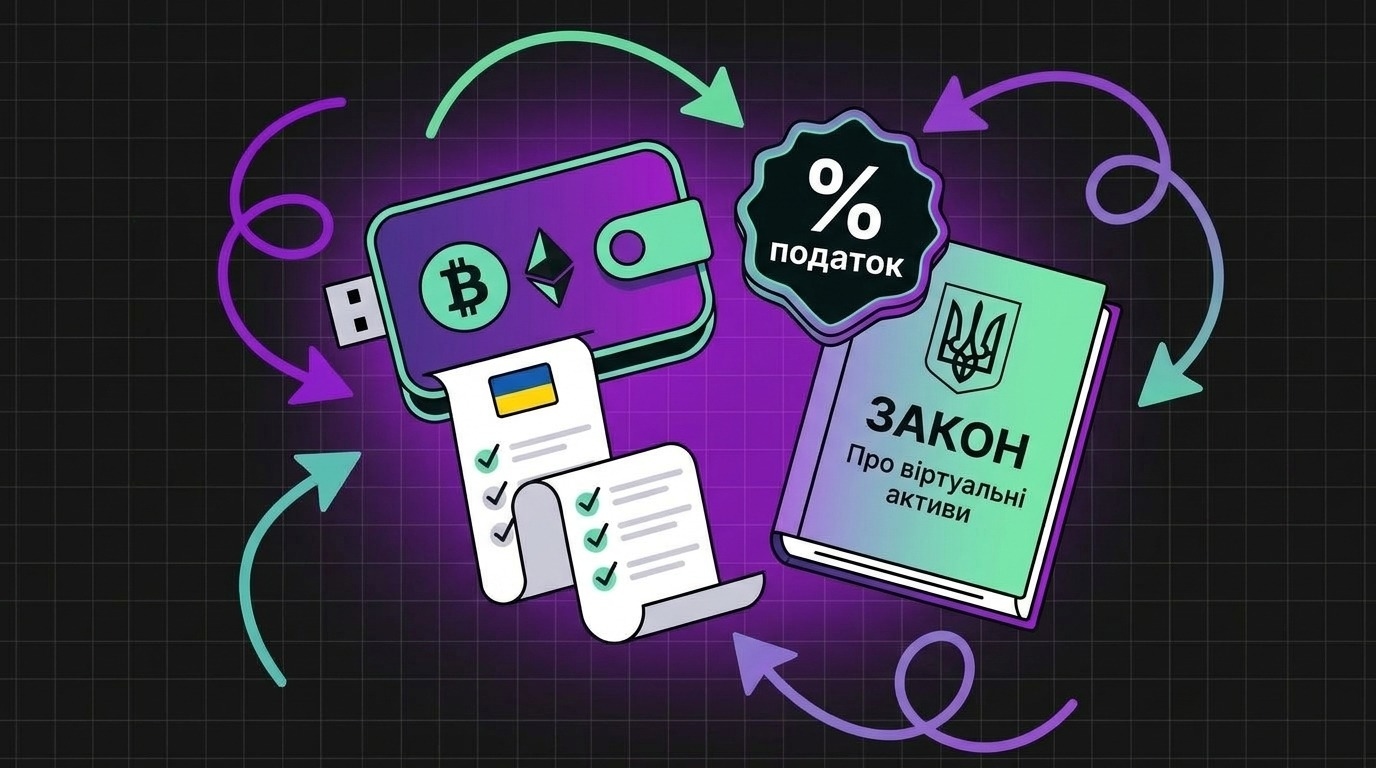
A card transfer, a couple of minutes, and the cash is already in your pocket—but starting July 1, 2027, moves like that will have the tax service, banks, and Law No. 10225-d, passed by Parliament, behind them.
Some are already gearing up for the apocalypse, while others shrug it off: there’s supposedly plenty of time before summer 2027. Both are missing the mark, because the real money and real risks aren’t hiding in the launch date—they’re in your receipts, your stablecoins, and whether you fall for the panic.
Let’s break down what’s changing for your wallet: where the tax math comes in, what smells like a scam, and what to do today so you don’t end up losing your crypto.
Taxes Without Illusions
In short: the state won’t take a cut of every swap you make between Bitcoin, ETH, or a stablecoin inside your wallet. Taxes kick in when you cash out to fiat—hryvnia, dollars, or euros—or pay with crypto for something real.
The base rate is 23% (18% personal income tax and 5% military levy), calculated not on the full amount, but on net profit. Buy for, say, 100k, sell for 150k, and you pay on the 50k—plus you can carry forward prior-year losses and use a small tax-free allowance.
The 10% Transitional Trap
Through the end of 2028, coins bought before July 1, 2027 qualify for a preferential 10% rate (5% personal income tax and 5% military levy). Sounds like a sweet deal at first, but the devil is in the tax base: that 10% applies to your entire sale proceeds, not just profit.
Say you bought coins for 20k hryvnia—or lost proof of purchase altogether—and sold them for 300k. Then 10% of proceeds (30k) beats 23% of the full sum without receipts (69k). On the flip side, if you bought for 250k, kept the receipt, and sold for 300k, 23% on 50k profit is just 11.5k versus 30k under the "preferential" rate.
P2P and Stablecoins
Grey schemes with cash-outs to random cards and back-alley cash deals are steadily losing their comfort zone. Exchanges and platforms serving Ukrainians will report client activity to the tax service once a year, leaving fewer and fewer blind spots.
Stablecoins like USDT or USDC are a separate piece of the puzzle. Since they count as e-money tokens, their circulation and approval in Ukraine are tightly tied to the National Bank’s stance—so blindly keeping all your capital in one stablecoin and ignoring listing rules is an unnecessary risk.
Fear-Driven Phishing
Wherever new laws and deadlines pop up, scammers follow right behind with emails about "urgent wallet verification before the law takes effect." It’s the oldest trick in the book: panic, a fake page, connecting your wallet, and signing a smart contract that drains your balance in seconds.
No tax authority or regulator can freeze your non-custodial wallet via an email link or ask you to sign sketchy approvals. If someone tries to scare you with a "legal freeze," take a breath, close the tab, and verify everything yourself.
What to Do Now
- Collect your trade history. Export CSV reports from exchanges and save deposit receipts so you aren’t estimating your cost basis on your fingers.
- Separate your wallets. Keep long-term holdings, active trading, and experiments with new protocols in separate places.
- Run your own numbers. Do the math on where 23% on profit works out better for you versus the transitional 10% on gross sales.
- Don’t fall for panic. Treat any urgent message about assets being frozen over Law No. 10225-d as potential phishing right away.
The Bottom Line
Law No. 10225-d doesn’t kill crypto in Ukraine, but it forces you to do the math with a clear head: heading into July 2027, the winner is whoever gets receipts and wallets in order early—not scrambling with a calculator in fire-drill mode.