OnChainWallet: Wallet, AML, and Payouts in One System
August 10, 2026
For a crypto exchange, a wallet directly affects several processes: receiving funds, AML checks, asset storage, customer payouts, and the cost of each transaction. If separate third-party services are used for these tasks, the business depends on their fees, limits, and operating rules.
OnChainWallet – is a non-custodial crypto wallet for exchange services that is installed on the owner's server. Private keys remain under the owner's control, while a single system can handle payment processing, AML checks, fund accumulation, and payouts.
What is OnChainWallet
OnChainWallet was developed by the Lyxonn team as an infrastructure solution for handling cryptocurrency payments. Unlike a regular mobile wallet, its main use case is built around the operational needs of an exchange service.
The system is hosted on the owner's server, allowing them to manage keys, addresses, access permissions, and wallet settings independently. Funds do not need to be transferred to a separate custodial provider for storage.
At the same time, some additional functions still rely on external integrations. For example, AML checks are performed through BitOK or AMLBot, TRON energy rental services can be connected, and additional assets may be processed through liquidity providers. This means the owner controls the keys and core infrastructure, while certain operational functions may depend on connected services.
How a payment is processed
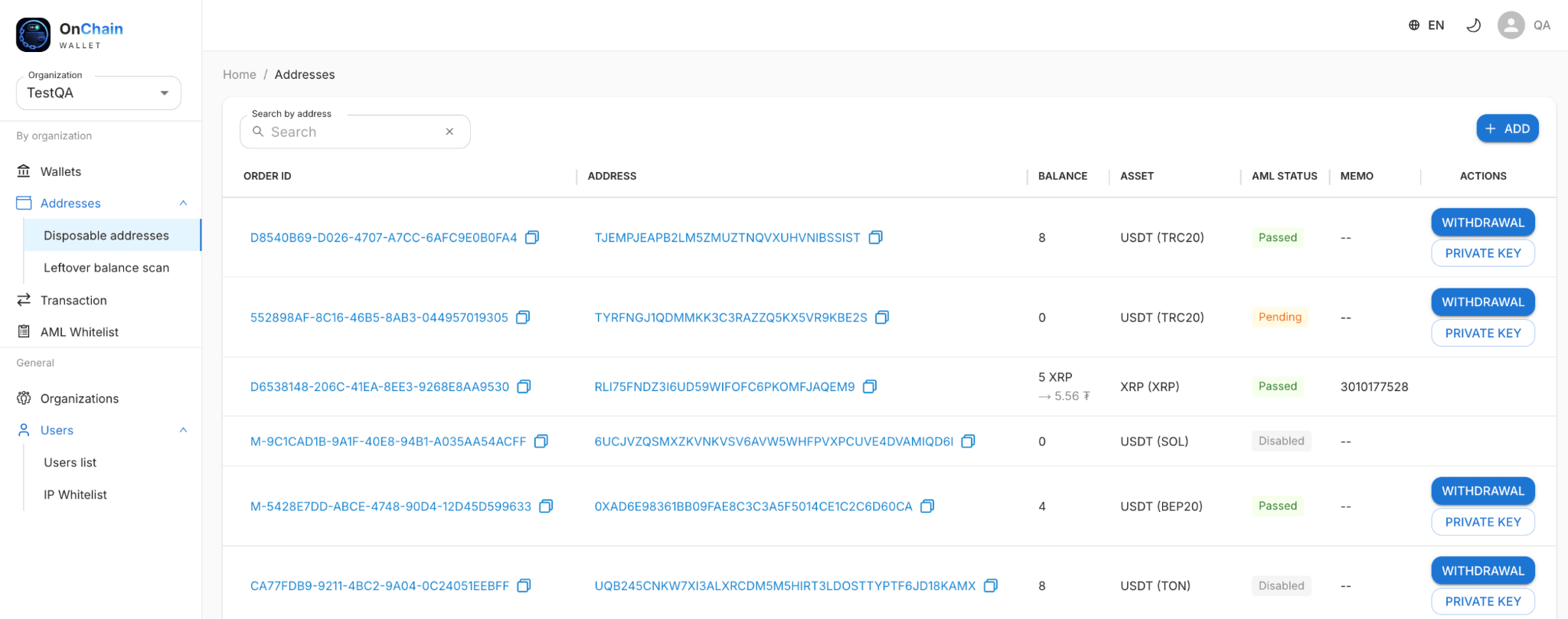
One of the key features of OnChainWallet is the ability to create a separate receiving address for each order.
When a customer creates an order on the exchange, the system generates an address and waits for the transaction. Once the funds arrive, they are checked according to the configured AML parameters. If the risk level meets the specified conditions, the funds can be automatically transferred to the main wallet.
This makes it possible to separate the operational logic of a specific order from the exchange's overall balance. If a transaction has an elevated risk level, it can remain on a separate address for further review instead of being automatically moved together with other assets.
Which networks and cryptocurrencies are supported
For its main operations, OnChainWallet supports USDT on TRC20, BEP20, ERC20, TON, and Arbitrum. The system also works with other assets, including ETH, BNB, TRX, LTC, XMR, USDC, and a range of other cryptocurrencies.
Another area of functionality is integration with liquidity providers. This expands the number of available assets and allows received coins to be automatically converted into USDT.
For an exchange, this setup can be useful when customers use many different coins while it is more convenient to maintain the operational balance primarily in stablecoins.
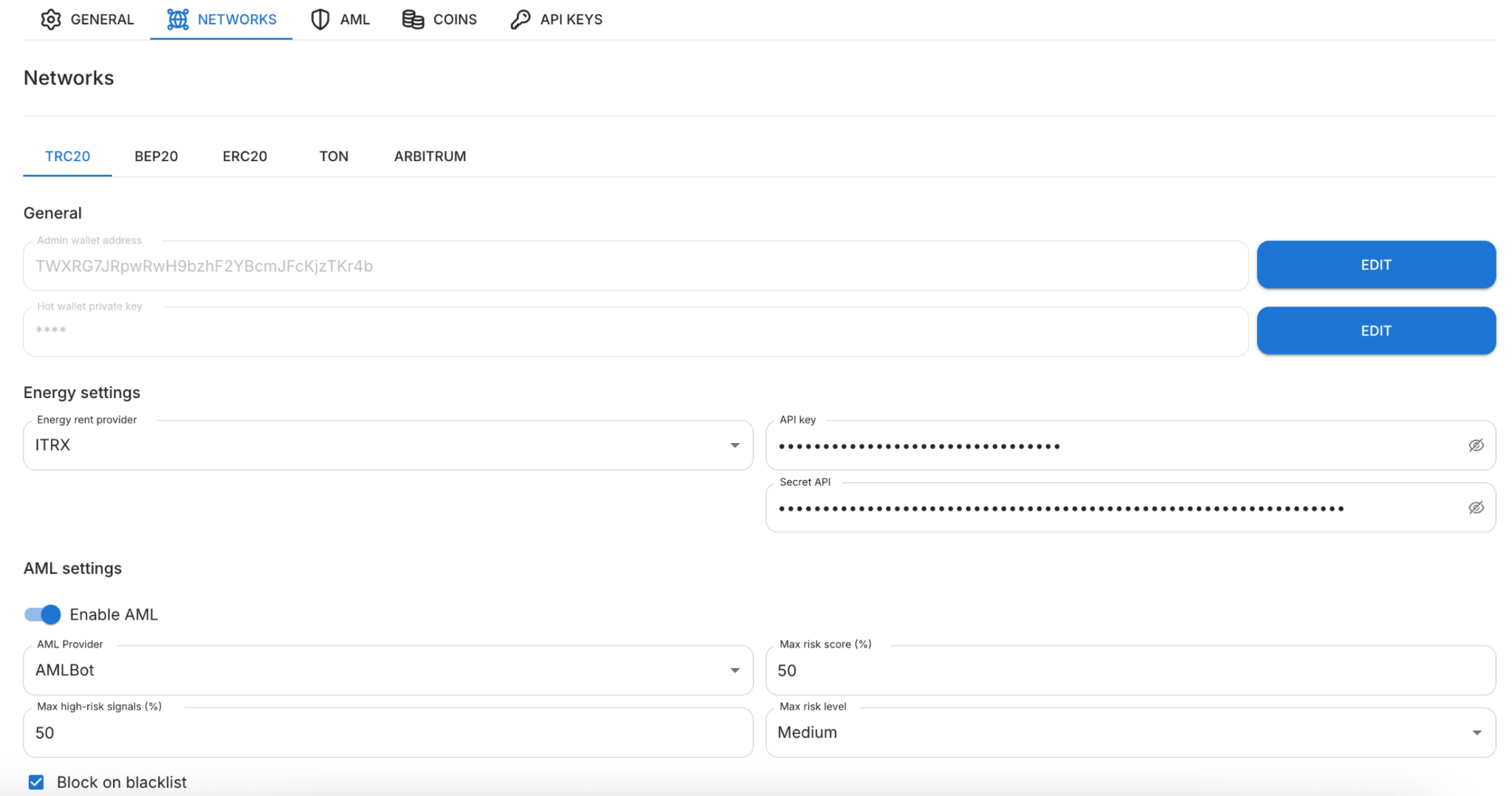
For each network, the main wallet, payment acceptance parameters, and AML checking rules can be configured separately. As a result, one network does not necessarily have to operate under the same logic as another.
AML checks before funds are moved
The AML integration in OnChainWallet is built around BitOK and AMLBot. The owner connects their own API keys and defines the parameters the system will use to evaluate incoming transactions.
It is possible to set an acceptable risk level, work with blacklist and whitelist addresses, and determine which payments can be processed automatically.
The process works as follows:
- The customer sends cryptocurrency to the address assigned to a specific order.
- The system receives the transaction and launches the AML check available for that network.
- If the risk level matches the configured parameters, the funds continue through the specified processing flow.
- If the check detects an elevated risk level, the transaction remains isolated for manual review.
This approach is particularly relevant for exchanges with a high transaction volume, where checking every address manually would be difficult. At the same time, the final AML rules are set by the service owner, so the result depends on the configuration and the data provided by the selected AML provider.
Certain networks may also have technical limitations imposed by AML services. For example, the current OnChainWallet documentation states that automatic AML checks for TON are not currently supported by the connected providers.
Cold and hot wallets handle different tasks
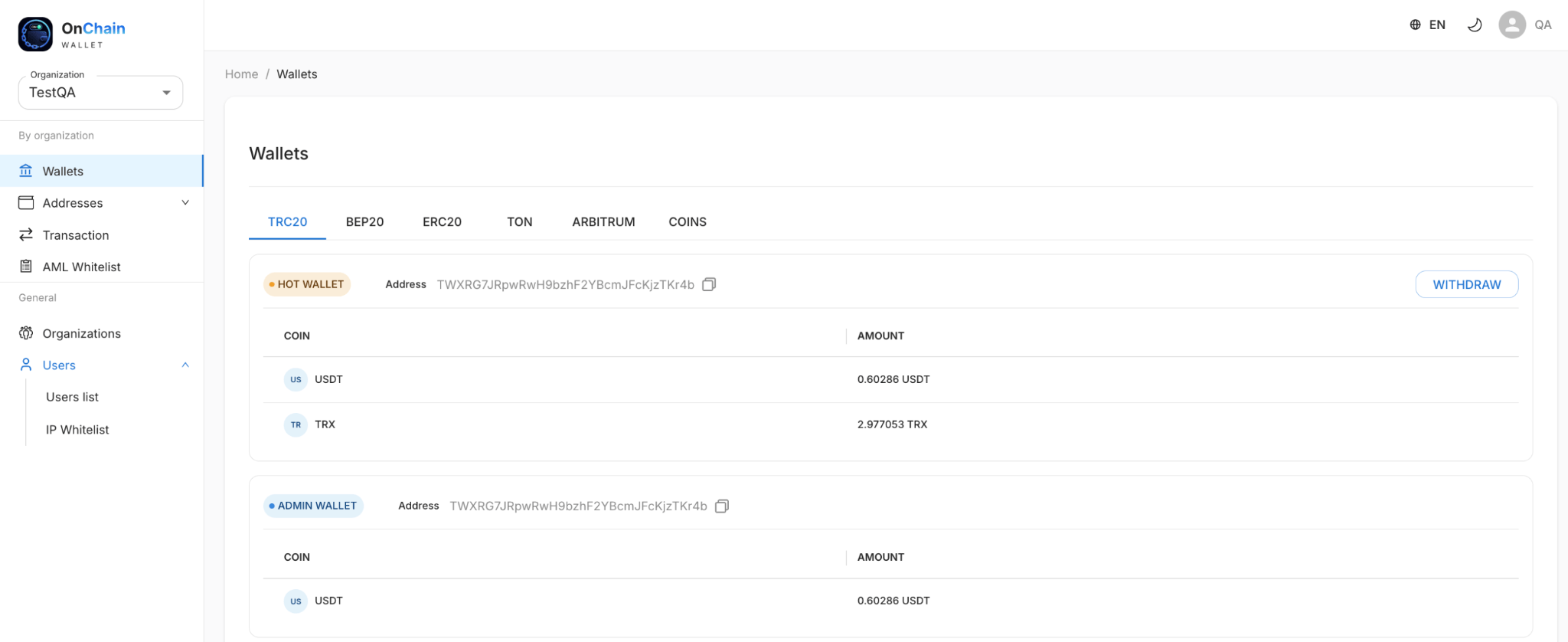
OnChainWallet separates the storage of primary funds from the balance used for ongoing payouts.
Once the required checks have been completed, assets can be accumulated in the main wallet selected by the owner. A separate hot wallet is used for payouts, and only the balance required for current operations needs to be transferred there.
This setup reduces the amount of funds continuously used in the operational environment. However, security depends not only on the architecture of OnChainWallet. The owner is responsible for protecting the server, private keys, API access, backups, and administrator accounts.
Two-factor authentication is available in the admin panel. An IP whitelist can also be configured for the API to restrict requests to servers that should have access to the system.
How OnChainWallet handles fees
One of the main reasons for moving to your own payment infrastructure is the cost of transactions.
For cryptocurrencies processed directly by OnChainWallet, the service does not state a separate percentage fee for receiving funds. The main costs are the fees of the relevant blockchain and any additional services the owner chooses to use.
Assets processed through integration with liquidity providers are subject to a separate fee. The documentation specifies a 0.2% fee on the amount, with a minimum fee of 0.5 USDT.
USDT TRC20 transactions are optimized separately. Transactions on TRON require network resources, so OnChainWallet allows energy rental services to be connected. The documentation lists Netts and ITRX. With a sufficient transaction volume, this can reduce the average cost of operations compared with paying standard fees without renting resources.
The OnChainWallet team provides examples of low transaction costs for BEP20, ERC20, Arbitrum, TRC20, and TON. However, the actual transaction cost depends on the network, its current load, transaction parameters, and external services, so these figures should be treated as estimates rather than fixed fees.
One wallet can be used for several exchanges
One OnChainWallet license allows up to three exchange services to be connected.
A separate organization with its own settings is created for each one. Different API keys, IP addresses, users, AML parameters, and other configurations can be used.
Changes made for one exchange should not affect the settings of other connected projects. This can be useful for teams managing several services that want to use one infrastructure while keeping access permissions and operational processes separate.
An API is available for automation. Through it, the system can create addresses for orders, check balances, initiate payouts, and send transaction statuses back to the exchange website.
Ready-made integrations with Premium Exchanger and LARA are also available, simplifying the connection process for exchanges already using these solutions.
How much does OnChainWallet cost
At the time this article was prepared, a one-time OnChainWallet license costs $4,800. The team also offers payment in installments over 12 months with no interest.
Server security configuration can be ordered separately for $350, while installation and launch cost $280. The full package of these additional services costs $630.
Basic updates and technical support are included in the license. Installation can also be completed independently using the documentation if the team has a specialist experienced with server infrastructure.
The economics should be calculated for each specific exchange. A one-time license can be a significant expense for a service with a small number of orders, while with a high transaction volume, lower fees and the absence of percentage charges for core operations may have a more noticeable impact on overall costs.
Who may benefit from OnChainWallet
The product is primarily aimed at owners of crypto exchanges and other services that need their own infrastructure for receiving and sending cryptocurrency.
It makes the most sense when the service processes enough transactions for third-party processing costs to become a noticeable part of the budget. The solution may also be useful for teams that want to manage private keys, AML rules, balances, and access permissions independently.
Running your own infrastructure also brings greater responsibility. The server must be properly secured, access permissions controlled, backups maintained, and integration settings monitored. With a custodial service, some of these tasks are handled by the provider, while here they become the responsibility of the exchange team.
Conclusion
OnChainWallet combines a crypto wallet with a set of tools for automating exchange operations. The system creates separate addresses for orders, integrates AML checks, separates primary storage from payouts, supports an API, and allows several exchange services to be managed through one infrastructure.
The key feature of this approach is control over keys and operational logic. The exchange decides where funds are stored, which AML rules are applied, how much is kept in the hot wallet, and which external integrations are connected.